
A Quarter Review
Macro crosscurrents defined the third quarter, contributing to heightened volatility across SMID-cap equities.
Corporate earnings reports continued to reflect a recovery from the 2024 cyclical trough. Second-quarter earnings grew 33%, marking the strongest rate of growth in more than four years. The improvement was particularly evident in areas benefiting from increased capital spending tied to artificial intelligence infrastructure and related technologies. Despite robust earnings growth, equity performance reflected cooling investor enthusiasm toward this dominant market theme, and momentum-oriented stocks experienced a sharp correction during the quarter.
Higher interest rates also weighed on equities, particularly among lower-quality and smaller-capitalization companies. The Federal Reserve raised short-term interest rates for the first time in three years amid renewed inflation concerns. Higher oil prices added to inflationary pressures, pushing the 10-year Treasury yield above 5% for the first time since 2007.
Energy was the strongest-performing sector during the quarter as ongoing conflict in the Middle East drove fuel prices higher. Industrials and Consumer Discretionary were among the weakest-performing sectors, with some companies facing pressure from higher borrowing costs and increased financial strain.
Performance Summary
The SMID Cap Core Strategy returned -0.56%, net of fees, during the quarter, comparing favorably with the Russell 2500 Index return of -6.37%. The Strategy's disciplined focus on quality and valuation aligned well with a market environment that rewarded companies with stronger fundamentals and valuation support.
Performance attribution indicates that positive security selection was the primary driver of relative outperformance, with the portfolio generating higher relative returns in eight of the eleven sectors. Health Care, Technology, and Industrials were the largest contributors to relative performance during the quarter. The portfolio's two best-performing holdings were Health Care companies Halozyme Therapeutics and Charles River Laboratories. Technology and Industrials positioning also benefited from significant profit-taking in expensive momentum stocks, an area where the portfolio maintains limited exposure. Companies with elevated exposure to semiconductor and AI-related capital expenditure trends generally declined during the period.
Meanwhile, out-of-favor software companies, which had become deeply discounted amid concerns about AI-driven disruption, experienced a strong rebound and contributed positively to portfolio results.
The portfolio also benefited from its overweight allocation to mid-cap companies relative to the benchmark, as small-cap stocks significantly underperformed during the quarter.
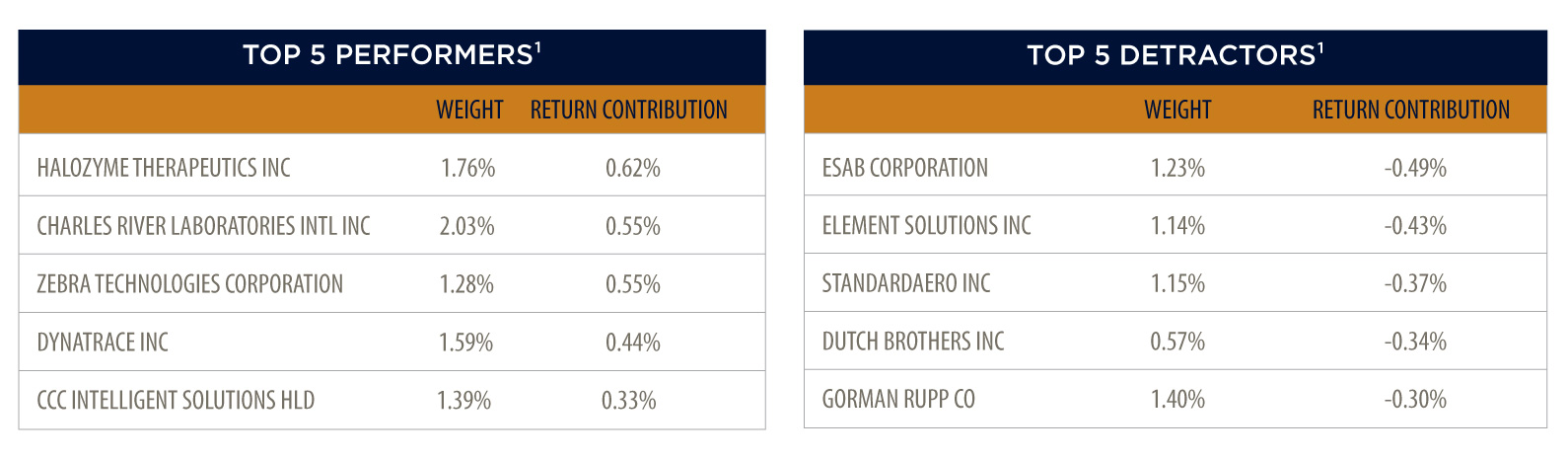
1) Past performance is not indicative of future results, and there is a risk of loss of all or part of your investment. The above does not represent all holdings in the Strategy. Holdings listed might not have been held for the full period. To obtain a copy of Johnson Asset Management’s calculation methodology and a list of all holdings with contribution analysis, please contact your service team. The data provided is supplemental. Please see important disclosures at the end of this document.
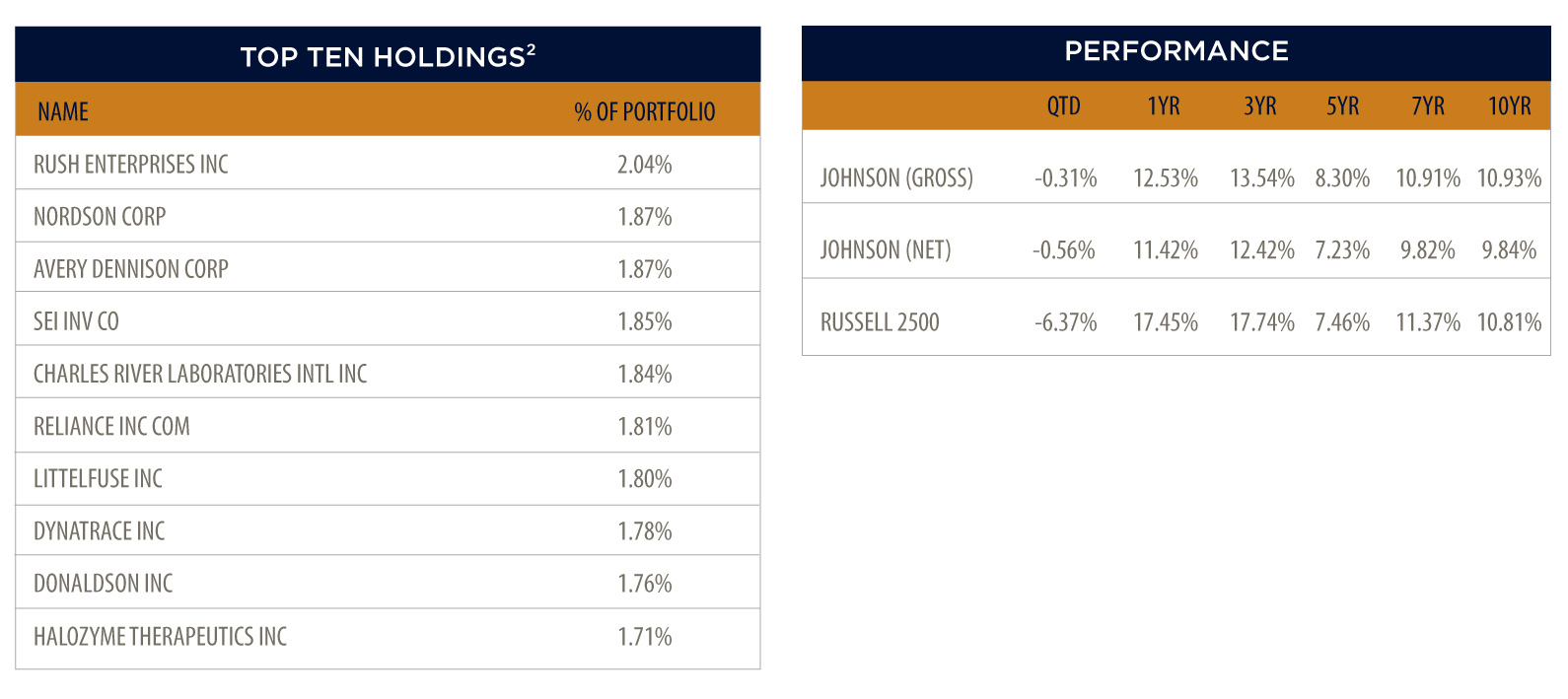
2) Holdings are subject to change. Past performance is not indicative of future results, and there is risk of loss of all or part of your investment. The data provided is supplemental. Please see disclosures at the end of this document.
Market Outlook and Portfolio Positioning
Many of the factors that shaped third-quarter market performance remain unresolved, and market direction will likely continue to be influenced by the trajectory of earnings growth and interest rates.
While earnings growth has remained strong, valuations have compressed as investors assess the sustainability of current growth trends. The outlook for interest rates will likely depend on developments in the Middle East and the Federal Reserve's ongoing response to inflationary pressures. Policymakers continue to face a challenging balance between managing inflation and supporting economic growth.
Against this backdrop, the Strategy's emphasis on high-quality businesses, attractive valuations, and lower-volatility characteristics positions the portfolio well for an environment marked by elevated uncertainty and increased market dispersion.
The Johnson SMID Cap Core Equity Strategy seeks to consistently outperform the Russell 2500 Index over a full market cycle with less volatility. The Strategy seeks to identify stocks that are making smart allocation decisions, with a favorable combination of quality, valuation, and momentum characteristics. For more information on our products and services, please contact a member of our Sales & Client Service Team at 513.389.2770 or info@johnsonasset.com.
Published 11/06/2026
The Russell 2500 Index is unmanaged, does not reflect the deduction of fees, transaction costs, or other expenses, and cannot be invested in directly. Index returns assume reinvestment of dividends. The index is shown for comparison only. The Strategy's holdings, sector weights, market-capitalization mix, and risk characteristics differ from the index, so its performance and volatility may differ materially. Returns for periods longer than one year are annualized. The commentary contains the opinions of Johnson Asset Management's investment team as of September 30, 2026. These opinions may change without notice and should not be read as investment advice or a recommendation to buy, sell, or hold any security or sector. Statements about earnings growth, interest rates, inflation, valuations, geopolitical developments, or portfolio positioning are forward-looking. They are based on current expectations and assumptions that may prove wrong, and actual results may differ materially. References to specific securities are for illustration only. It should not be assumed that investments in the securities identified were or will be profitable. Top performers and detractors reflect each holding's contribution to the return of a representative account in the SMID Cap Core Equity Composite for the quarter. They are selected by contribution using objective criteria applied consistently each period, not by performance results. Equity investments are subject to market, sector, and issuer-specific risk, and you may lose money. Johnson Asset Management (JAM) is a division of Johnson Investment Counsel, Inc. (“JIC”), an independent and privately owned Midwestern based investment advisory firm registered with the Securities and Exchange Commission. Johnson Asset Management manages institutional separate account portfolios for a wide variety of for-profit and nonprofit organizations, public agencies, public and private retirement plans, and personal trusts of all sizes. It may also serve as sub-adviser for mutual funds. JIC’s fees are available upon request and may be found in our Form ADV Part 2A. Performance data quoted herein represents past performance. Past performance does not guarantee or indicate future results. All data is current as of September 30, 2026 unless otherwise noted. Returns and net asset value will fluctuate. To determine if this strategy is appropriate for you, carefully consider the investment objectives, risk factors, and expenses before investing. Individual account management and construction will vary depending on each client's investment needs and objectives. Investments employing JIC’s strategies are NOT insured by the FDIC or by any other Federal Government Agency, are NOT Bank deposits, are NOT guaranteed by any Bank or any Bank affiliate, and MAY lose value, including possible loss of principal. Johnson Asset Management claims compliance with the Global Investment Performance Standards (GIPS). GIPS® is a registered trademark of CFA Institute. CFA Institute does not endorse or promote this organization, nor does it warrant the accuracy or quality of the content contained herein. A complete list of firm composites and performance results and the policies for valuing portfolios, calculating performance, and preparing GIPS compliant presentations are available upon request by calling 513-389-2770. Composite: The Johnson SMID Cap Core Equity Composite was created on January 1, 2013, and includes all of JIC’s fee paying, fully discretionary institutional equity portfolios with a minimum of $1,000,000 and an investment objective of small and mid-cap equities. The benchmark for this composite is the Russell 2500, a broadly diversified mid and small cap equity universe of U.S. companies. Eligible new portfolios are included in the composite the first full month after being deemed fully invested. The returns from terminated portfolios are included prior to the date of termination. Effective January 2010, a portfolio will be temporarily removed from this composite if it experiences a net inflow or outflow of cash of 30% or more during a one-month period. Portfolios in this composite include cash, cash equivalents, investment securities, interest and dividends. The U.S. dollar is the base currency. All returns reflect the reinvestment of investment income (dividends and/or interest) and capital gains. Valuations and returns are stated in U.S. dollars. Trade date accounting is used. Portfolio returns are calculated using time weighed return methodology on a monthly basis. Net returns shown reflect gross performance less the highest fee schedule for this strategy. The highest investment management fee schedule for this strategy is 1.00%. Actual client returns could also be reduced by brokerage commissions, custodial fees, and other client paid expenses detailed in JIC’s Form ADV Part 2A.